 HubSpot
 Jipup
GTM engineering is becoming a common name for work that used to fall between RevOps, sales operations, data engineering and growth. The title is new enough that two job descriptions can mean different things. The useful definition is not a list of tools. It is the ability to turn a commercial decision into a repeatable system with inputs, rules, an owner and a measurable output.
That distinction matters. A workflow that enriches contacts, scores accounts or alerts a rep is not useful just because it runs. It needs known inputs, a defined action, and a way to spot mistakes. The strongest GTM engineering teams build that control into the workflow before they add automation.
This guide explains what GTM engineering is, what a GTM engineer actually builds, and how to choose a stack that does not create another disconnected layer over your CRM.
What is GTM engineering ?
Short answer: GTM engineering is the practice of building and operating the systems behind a go-to-market motion. It connects business rules to data, integrations and workflows so sales, marketing and customer-facing teams can act on the same information.
The role sits between commercial strategy and technical execution. A leadership team may decide to target a new segment. A GTM engineer translates that decision into an ICP definition, data requirements, routing rules, workflows and reporting. The job is not simply to buy more software or to create one-off automations.
The leading results for this query agree on the hybrid nature of the role. SMARTe describes a GTM engineer as someone connecting CRM, analytics and automation. PromptLoop frames the role around technical skill and market understanding. LeadIQ focuses on integrations, workflow automation, sales enablement and GTM data. They are useful starting points, but they leave out the operational test: can a teammate explain why a record entered the workflow, what changed, and who owns an exception ?
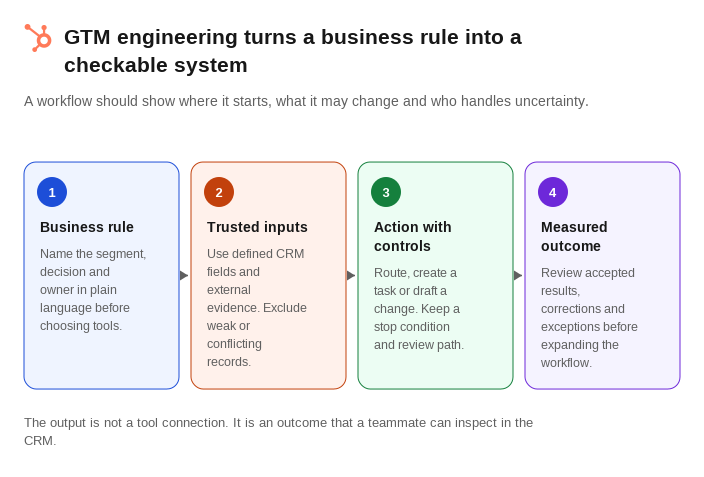
That is the angle to use when evaluating GTM engineering. The output is a governed system, not an impressive diagram.
What does a GTM engineer actually build ?
Short answer: A GTM engineer builds the connections and operating rules behind a revenue workflow. Typical work includes preparing CRM data, connecting tools, routing records, creating repeatable actions and measuring whether the action improved the process.
The work usually appears in five layers. A small company may have one person covering all of them. A larger company may distribute them across RevOps, data and engineering. The layers still need one shared contract.
| Layer | Question it answers | Example output |
|---|---|---|
| Commercial rule | Who should receive which action, and why ? | A documented definition of an in-market account |
| Data foundation | Which fields and sources can support that rule ? | A clean account, contact and ownership model |
| Activation | What happens when the rule is met ? | Routing, an alert or a review task in the CRM |
| Controls | What must not happen automatically ? | Blank-only write rule and exception queue |
| Measurement | Did the workflow create the intended result ? | Weekly view of accepted outcomes and exceptions |
Consider a common request: alert a rep when an account shows a buying signal. The weak version connects a data source to Slack and sends alerts. The engineered version defines the target segment, verifies the account match, checks whether there is an owner and an open opportunity, creates one next step in the CRM, and records whether the action was useful. The latter can be reviewed and improved.
This is why GTM engineering is related to RevOps without being interchangeable with it. RevOps owns the operating model and outcomes across teams. A GTM engineer is often the builder who makes a focused part of that model work. The boundaries should be explicit in your organization, especially for CRM ownership and production changes.
Jipup gives new accounts a free, read-only CRM audit and 250 credits. Find the records and fields that need work before you automate a GTM motion.
What is in a practical GTM engineering stack ?
Short answer: A practical GTM engineering stack has a system of record, reliable inputs, a way to orchestrate actions, and a way to observe results. Start with the fewest components that can support one workflow safely.
Tool names vary. The jobs do not. Start with this stack map before evaluating vendors or asking a GTM engineer to build a play.
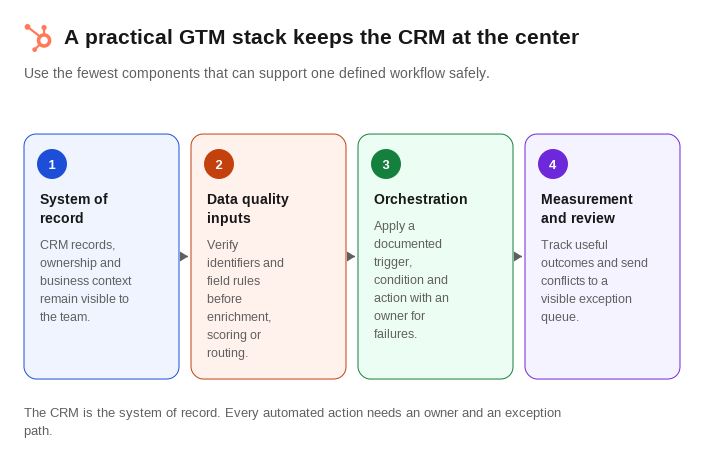
- CRM, the system of record. HubSpot or Salesforce should hold the records, ownership and business context that teams use to work. A workflow can read from other systems, but it should not leave key actions and outcomes invisible in the CRM.
- Data quality and enrichment. The workflow needs identifiers it can trust. Before you add scoring or personalization, decide which fields are required, who owns them, whether a value can be overwritten, and where uncertain records go. Our guide to waterfall enrichment explains how to test several data sources without turning every returned value into a CRM write.
- Orchestration and integration. This layer moves information between the systems and applies a rule. It can be native CRM automation, an integration platform, custom code or an agent. The choice matters less than a visible trigger, clear error handling and an owner for failures.
- Action surface. The result must land where a person or approved automation can use it: a CRM task, a routed owner, a queue, or a reviewed draft. An alert with no owner is not activation.
- Measurement and exception handling. Keep the initial success measure close to the workflow. For example, track records correctly routed, accepted enriched values or tasks completed after a verified signal. Track failures, conflicts and manual corrections beside it.
The stack should be smaller than it first appears. If you cannot state the trigger, required inputs, action and owner in one sentence, another tool will not fix the design.
How to build your first GTM engineering workflow
Short answer: Start with one narrow workflow that has a known business owner and a reversible action. Define the rule before the tools, test it on a small segment, inspect exceptions, then expand only after the result is useful.
Use a workflow that is frequent enough to learn from, but limited enough that a mistake does not affect your whole CRM. Examples include assigning inbound leads with complete fields, finding contacts that changed companies for review, or flagging accounts that match a documented segment.
- Write the business rule in plain language. Example: “When a new inbound company matches our target segment and has no owner, create a review task for the territory lead.” Avoid vague requests such as “prioritize good leads.”
- List the inputs and their owners. Name the CRM properties, the source of each external field, and the minimum evidence required. Exclude records with weak identifiers rather than forcing a match.
- Set the action and the stop condition. Decide whether the workflow creates a task, assigns an owner, drafts a message or only produces a review queue. State what makes it stop or wait for a person.
- Choose the smallest implementation. Native CRM automation may be sufficient. Use an integration, code or AI agent only where the rule requires it. Complexity has to earn its place.
- Test a small segment. Compare the outcome against the source records. Check false positives, missing records, duplicate actions and the time it takes an owner to resolve an exception.
- Instrument the result. Save a workflow status, run date or review outcome where your team can find it. A dashboard that only counts executions cannot tell you whether the system helped.
- Review before scaling. Keep an exception queue and make a named person responsible for the rule. Change one variable at a time when you adjust the workflow.
For CRM work, use a read-first approach. Jipup can start with a free, read-only CRM audit to show missing, stale or duplicate data before you decide which records a workflow may change. If you later use an agent, keep the source, target field, allowed action and review path explicit.
What skills does a GTM engineer need ?
Short answer: A GTM engineer needs enough technical skill to understand data, APIs and workflow behavior, plus enough commercial context to decide which work is worth automating. The most important skill is turning an ambiguous request into a testable operating rule.
The mix depends on the company. A team with a data platform may need stronger SQL and data-modeling skills. A lean startup may value fast prototypes and integration knowledge. Technical depth is useful, but it is not a substitute for business judgment.
| Skill area | What good looks like | Test it with |
|---|---|---|
| CRM and data model | Understands properties, associations, ownership and data quality | Can explain the minimum fields a routing rule needs |
| APIs and integrations | Can read documentation, handle authentication and diagnose failures | Can describe what happens when an upstream value is missing |
| Workflow design | Separates trigger, condition, action and exception | Can draw the stop condition before building |
| Measurement | Connects execution to an observable outcome | Can name the success metric and the failure metric |
| Commercial context | Understands how sales and marketing actually use the output | Can reject a technically possible workflow that has no owner |
Do not hire or train for a generic tool list. Ask for a walkthrough of a real workflow: its inputs, its rules, the records it leaves alone, its owner and its correction path. That reveals more than whether someone can name a popular automation product.
Common GTM engineering mistakes
Short answer: The common mistake is automating an unclear decision. Other failures follow from it: bad inputs, too many tools, invisible exceptions and a success metric that counts activity instead of useful outcomes.
Treating enrichment as truth. A returned field is a candidate value, not proof. Set acceptance and overwrite rules before writing to the CRM. Keep a record of the source when practical.
Building around tools instead of a rule. “We have an AI agent” is not a workflow. Name the event, records, decision and action. If the rule changes every day, it is probably not ready for automation.
Hiding failure states. A workflow that fails quietly creates false confidence. Send failed matches, conflicts and permissions errors to a visible queue with an owner.
Creating actions with no recipient. A lead score or signal that does not create a clear, owned next step becomes noise. The action surface and owner need to be designed with the rule.
Counting runs as impact. A thousand workflow executions may be worthless if they created duplicate tasks or sent weak records to the wrong team. Measure accepted outcomes and corrections, not only throughput.
FAQ
What is the difference between GTM engineering and RevOps ?
RevOps is the broader operating model for aligning revenue teams, processes and measurement. GTM engineering is usually the technical and operational work of building focused systems inside that model. The exact split depends on the company, so define CRM ownership and decision rights clearly.
Is a GTM engineer a software engineer ?
Sometimes, but not always. The role can require APIs, data work and scripting, while other teams rely more on native CRM automation and integration tools. The consistent requirement is the ability to build and operate a reliable system for a commercial workflow.
Does a GTM engineer need to know SQL ?
SQL is valuable when the work involves a warehouse, large datasets or complex measurement. It is not the only useful skill. A GTM engineer also needs to define data rules, understand workflow failures and work with the teams using the output.
What should a GTM engineer automate first ?
Start with a narrow, repeatable workflow that has a known owner, trustworthy inputs and a reversible action. Test it on a small segment before allowing broad CRM writes or sending high-volume communications.
Can AI agents replace GTM engineering ?
AI agents can implement or assist parts of a workflow, but they do not remove the need for rules, permissions, data quality and review. An agent needs the same inputs, boundaries and exception path as any other production system.
How do you measure GTM engineering ?
Measure the business outcome of a specific workflow, such as correctly routed records, accepted data values or completed follow-up after a verified event. Also track exceptions, manual corrections and duplicate actions so the team can see the cost of errors.
Where Jipup fits
Jipup gives new accounts a free, read-only CRM audit and 250 credits. Find the records and fields that need work before you automate a GTM motion.

Co-founder of Jipup, the AI agent that keeps HubSpot CRMs clean, up to date and enriched. He works every week with RevOps and sales teams on their CRM data.